
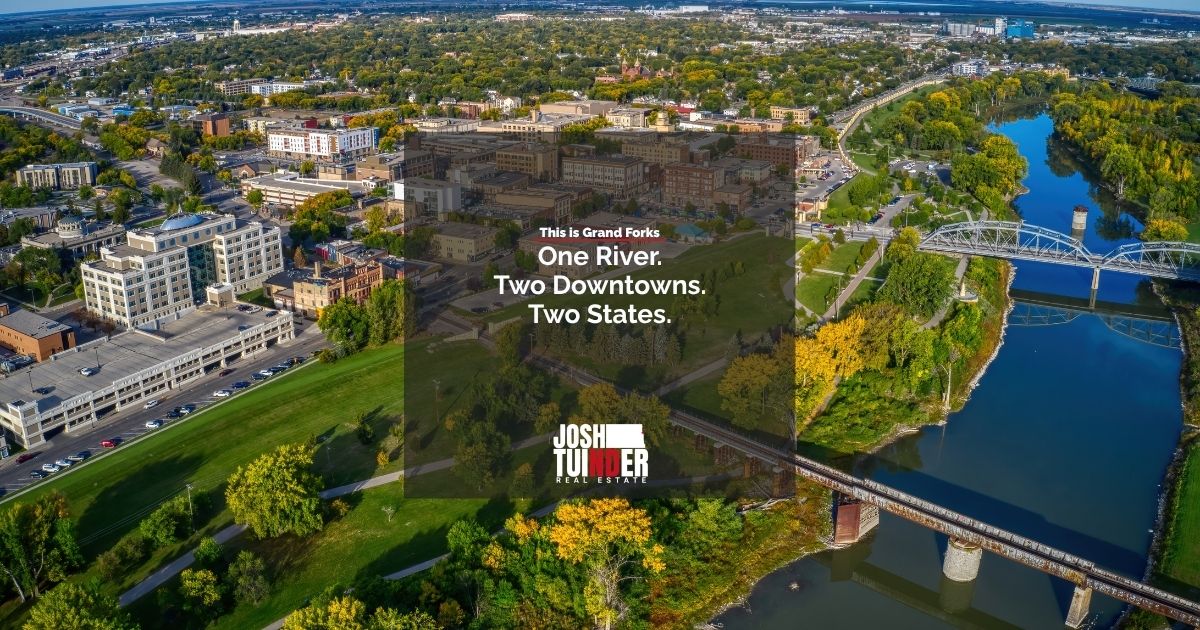

Grand Forks, North Dakota and East Grand Forks, Minnesota are two separate cities in two separate states, connected by a bridge you can cross in about a minute. Grand Forks has roughly 60,000 people. East Grand Forks has roughly 9,000. Same river valley, same weather, same winter, two state governments, two school districts, two sets of laws. People here cross that river without thinking about it, several times a week, for work, for dinner, for a store that only exists on one side. In most towns, crossing to the other side means a different neighborhood. Here it means a different state.
I drove that bridge twice a day for years
My kids went to Riverside Christian School on the East Grand Forks side, kindergarten through eighth grade. Every school day. Over in the morning, back in the afternoon, then over again for pickup. Different state, different set of laws, different everything on paper, and it was just the drive to school.
That is the honest answer to what it is like living between these two towns. It stops being a border almost immediately. You cross it in your slippers to get a gallon of milk. My kids crossed a state line to learn long division and then came home to North Dakota for supper.
They started high school at Central, back on the Grand Forks side, and that switch felt bigger than the state line ever did.
The bridge is older than most of what it connects
The Sorlie Memorial Bridge carries DeMers Avenue over the Red River, straight out of downtown Grand Forks and into downtown East Grand Forks. It went up in 1929. It is named after Arthur Gustav Sorlie, a governor of North Dakota, and it is owned by the Minnesota Department of Transportation, which tells you just about everything about how these two towns operate. Nobody is keeping score on whose is whose. It is 603 feet of through truss, and if you have driven it in February you know the wind comes down that river valley like it has somewhere to be.
Keep that 1929 date in your pocket. We are coming back to it.
What actually changes when you cross
Grand Forks is not a big city. Nobody is confusing it with Minneapolis. But put it next to East Grand Forks and the difference is wild.
Grand Forks has two public high schools, Red River and Central. East Grand Forks has one. Grand Forks has two Walmarts and a Target and enough retail that you only drive to the Cities for the truly niche stuff. Grand Forks has the Ralph, a hockey arena built on a $104 million gift from Ralph Engelstad, which at the time was the largest single donation by one person to an institutional project in North Dakota history.
East Grand Forks has a McDonald’s, a Dairy Queen, a grocery store, and a sugar beet plant. American Crystal Sugar has run a factory there for decades, and during campaign you know it, because the trucks are everywhere and the whole place smells like work getting done.
One is a small city. The other is a small Minnesota town. Only the river separates them.
East Grand Forks was once called Little Chicago
This is the part almost nobody who moved here in the last fifteen years has heard, and it is the best story in the valley.
North Dakota went dry in 1890. Not 1920. 1890. Thirty years before the rest of the country. And when North Dakota went dry, fourteen Grand Forks saloon keepers did the most reasonable thing a person can do, which is pick up their business and walk it across the river into Minnesota, where it was still perfectly legal.
By 1892 East Grand Forks had a brewery, a beer depot, and THIRTY THREE saloons. Twenty two of them were on the first block of DeMers Avenue. One block. By 1909 the count was 48 saloons plus twelve breweries. Polk County finally voted itself dry in 1915, and the operators did what operators do. The saloons became “soft drink parlors,” which fooled exactly nobody, and the slot machines and roulette and blackjack moved into the back.
That is how East Grand Forks got the nickname Little Chicago.
So when the Sorlie Bridge opened in 1929, it was not connecting two sleepy downtowns. It was paving the route. The town finally voted the whole underground economy back into daylight in 1947, two to one.
Local legend says Whitey Larson knew Al Capone, and that Capone’s people were supplying the whiskey coming down from Canada. I will be straight with you: that has never been confirmed. It has also never been denied. Around here that counts as a pretty good story either way, and Prairie Public’s Dakota Datebook handles the Capone connection honestly, as local tradition rather than proven fact. Take it for what it is.
The bar that survived all of it
Edwin “Whitey” Larson opened the Coney Island Lunchroom in East Grand Forks in 1925, five years into federal Prohibition, and ran it about how you would expect. In 1932 he brought in architect Samuel DeRemer, redid the place in Art Deco, and installed what is credited as the first stainless steel horseshoe bar in the United States. By the late 1930s the Saturday Evening Post and Time were writing about a bar in East Grand Forks, Minnesota.
Then came 1997. The flood pushed Whitey’s off its original spot and up DeMers Avenue, farther from the river and behind the protection. They took the bar with them. The building moved. The horseshoe did not get left behind.
Whitey’s closed for good in September of 2017 after more than ninety years. Sickies Garage came in, then went. And in 2022 Nick Hagen, a local farmer, and his wife Molly Yeh opened Bernie’s at 121 DeMers Avenue, named after their daughter Bernadette. If the name Molly Yeh rings a bell, it should. She hosts Girl Meets Farm on Food Network, she farms right here in the valley, and she put her restaurant in a Prohibition speakeasy instead of anywhere else in the country she could have put it.
They kept the horseshoe bar. It is 96 years old, it got a deep clean and fresh paint, and it works as the takeout counter now. They even pulled the letters for the new sign out of the old Whitey’s Wonderbar sign, because every letter they needed was already hanging up there.
A bar built by a Prohibition operator in 1932, moved by a flood in 1997, still standing in 2026 with people ordering breakfast off it. That is East Grand Forks in one object.
What we actually cross the bridge for
No real estate angle here. This is just what people do.
Grand Forks folks go east for Cabela’s and Bass Pro at 210 DeMers Avenue, which is the same street the saloons were on, across the street from where Bernie’s sits now. Half of us are not even shopping. We are walking the taxidermy like it is a museum, because it is, and it is free. Then it is the Blue Moose Bar and Grill for food.
East Grand Forks folks come west for hockey. That is the trade. They bring the crowd, we bring the barn.
And the best nights of the whole year are the Gambucci Cup. East Grand Forks, Grand Forks Central, and Grand Forks Red River, three schools across two states, playing a series for a trophy that travels. When East Grand Forks took it in January of 2025, one of their players said they had not won it in nine or ten years. That is the kind of thing that only means something in a place where everybody’s families already know each other. Two states, one river, a whole lot of hollering across a sheet of ice. You cannot manufacture that.
The honest tradeoff
Small town charm is real and it also means fewer options. East Grand Forks gives you quiet streets, a short drive to everything in Grand Forks, and a school district where your kid is a name and not a number. It also means crossing the bridge for most of your shopping, and living under a different state’s rules for taxes, licensing, and how a closing gets handled. That last one catches people, and it is big enough to deserve its own post rather than a paragraph here.
Neither side is the right answer. They are just different answers, and which one fits depends on what you want your Tuesday to look like. I drove my kids across that bridge for years and never once thought of it as leaving town.
FAQ
Are Grand Forks and East Grand Forks the same town?
No. They are two separate cities in two different states, with separate governments, school districts, and laws. Grand Forks is in North Dakota with roughly 60,000 people. East Grand Forks is in Minnesota with roughly 9,000. They sit directly across the Red River from each other and function day to day like one community, but legally they are entirely distinct.
Why was East Grand Forks called Little Chicago?
North Dakota banned alcohol in 1890, thirty years before national Prohibition. Grand Forks saloon keepers moved across the river into Minnesota, where it was still legal. East Grand Forks had 33 saloons by 1892 and 48 by 1909. After Polk County went dry in 1915, speakeasies and underground gambling took over, and the nickname stuck.
Is the original Whitey’s horseshoe bar still there?
Yes. The stainless steel horseshoe bar was installed in 1932 and is credited as the first of its kind in the country. It survived a kitchen fire, moved up DeMers Avenue after the 1997 flood, outlasted the closing of Whitey’s in 2017, and now serves as the takeout counter at Bernie’s at 121 DeMers Avenue.
Can my kids go to school on the other side of the river?
Yes, and plenty of families do it in both directions. Mine went to Riverside Christian School in East Grand Forks from kindergarten through eighth grade while we lived on the Grand Forks side. Private schools make it simple. Open enrollment between public districts across a state line has its own paperwork, so check with both districts before you plan around it.
Which side of the river is cheaper?
It depends on the house, the year it was built, and what you are comparing. The bigger differences are property tax structure, insurance, and how closings work under two different states’ rules, and those can move your monthly payment more than the list price does. If you want real numbers for a specific comparison, I will pull current figures for both sides and walk you through them.
Next step: If you are moving to this area and trying to figure out which side of the river fits you, text or call me at 701.314.2202. The relocation guide covers the whole picture, both states included.
