

Test your house for radon. In North Dakota, 63 percent of homes come back above the EPA action level of 4.0 pCi/L, and all 53 counties sit in EPA Zone 1, the highest risk tier there is. Testing season is October through March, when the house is closed up and the number reflects how you actually live in it. A test costs nothing if you borrow a kit from the Grand Forks Public Library, or it runs as a small add-on to your home inspection. If it comes back high, mitigation around Grand Forks runs about $800 to $2,500, with most jobs landing between $1,200 and $1,500.
North Dakota is the worst state in the country for this, and nobody tells you that when you move here
There are only two states where every county is ranked Zone 1 by the EPA. North Dakota is one of them. You can look at the EPA’s radon zone map for North Dakota and the whole thing is one solid block of red. Grand Forks County, Traill, Walsh, Pembina, all of it.
The North Dakota Department of Environmental Quality puts it at 63 percent of homes above the action level. The national average indoor level is 1.3 pCi/L. We are not close to the national average and we never have been.
None of that means your house is a problem. It means your house is a question mark until somebody measures it, and the measuring is the cheap part.
The form you already signed mentions radon, and almost nobody reads that line
Every buyer I work with signs “For Your Protection: Get a Home Inspection.” Ours is the Grand Forks Area Association of REALTORS version, revised in 2023, written for use in North Dakota only. Partway down there is a paragraph with this heading: “Your Home Inspector may test for Radon, Health/Safety, and Energy Efficiency.”
It is right there, in the stack, in front of you, before you ever get to the inspection. It sits a few lines under the part that explains the appraisal is not a home inspection and does not replace one, which is a different hill I have already written about after an FHA appraisal called for roof repairs on an East Grand Forks deal.
I bring radon up out loud anyway. Not because the form is bad, but because a paragraph on page one of a document you are signing at the same time as nine other documents is not a conversation. My job is to make sure you heard it while you still have time to act on it.
Why October through March is the window
Radon comes up out of the ground and into the lowest level of the house. In the summer, with windows open and air moving through, you can get a reading that looks fine and tells you very little about January.
Heating season is the honest test. The house is shut, the furnace is pulling, and the number you get is the number you are actually breathing from October to April. That is why testing season opens right about now and why January is National Radon Action Month.
If you are buying this fall, this works in your favor. You are already inside an inspection period, and the conditions are already right.
What a test costs, which is usually nothing
Two paths.
Borrow a kit. The Grand Forks Public Library lends digital radon test kits for free. UND’s Radon Outreach and Research project, run out of the Department of Population Health, put them there, and UND has reported the kits are among the most frequently checked out items in the library. A university in our town studies this, and the result is free kits a few blocks from downtown. Use them.
Add it to your inspection. If you are mid transaction, this is the one I point people to. Your inspector places the test, it runs while the house sits closed, and the result comes back inside your inspection window with everything else. One scheduler, one report, one deadline.
A buyer I worked with this year moved up from California, where radon just is not the constant conversation it is here. I told her it is common in Grand Forks and that most houses here have some level of it. She said, “Thank you for explaining it to me. I understand it’s common, but I still want to know what I am dealing with.”
That is the right answer. Common is not the same as fine, and “everybody has some” is not a number. She ran the test through Blue Door Inspections and it came back at an acceptable level, and then she bought the house without wondering. The test did not change the deal. It changed how she felt signing.
If it comes back high
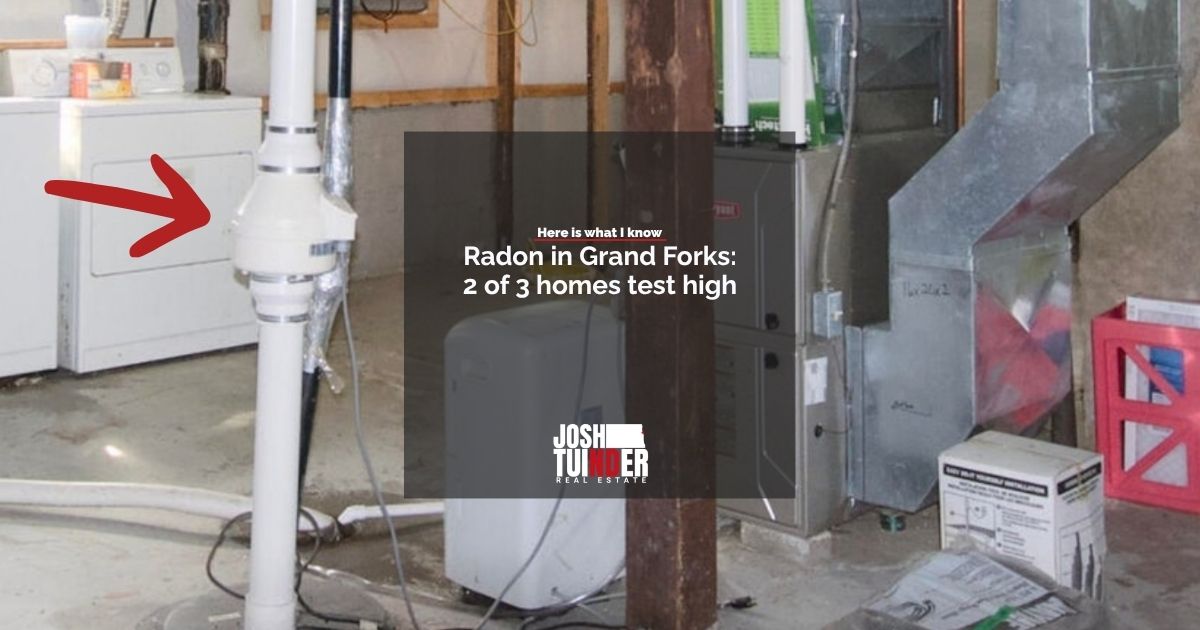
The fix is boring, which is the best thing about it. A mitigation system is a pipe and a fan that pulls air from under the slab and vents it above the roofline. It is not a renovation. Crews do it in a day.
Around Grand Forks, Radon B-Gon is the name that comes up most when I ask who people actually used. What I am seeing for cost is roughly $800 on the low end to $2,500 on the high end, with most houses landing in the $1,200 to $1,500 range as of fall 2026. UND’s reporting puts the statewide range a little higher, in the neighborhood of $1,200 to $2,400 and up, so budget toward the middle and be pleasantly surprised.
In a transaction, elevated radon usually becomes a negotiation, not a dealbreaker. Seller installs it before closing, seller credits it, or the two of you split it. I have never seen a Grand Forks deal die over radon alone. I have seen buyers wish they had asked earlier, when there was still an inspection period to ask inside of.
The tradeoffs, and what to verify
A short test is a snapshot. Radon moves with weather, soil moisture, and how the house is running. One winter test is enough to make a decision inside a transaction. It is not a lifetime certificate. Retesting every couple of years, and after any major foundation or HVAC work, is reasonable.
Closed-house conditions matter. If somebody props a basement window open during the test, the result is garbage. Ask your inspector exactly how long the house needs to be shut before and during the test, and then tell everyone with a key.
A system is not a permanent pass either. Fans fail. Most have a manometer on the pipe, the little U shaped gauge with colored fluid. If the fluid is level on both sides, the fan is not pulling. Look at it once a year.
Buying in East Grand Forks changes the paperwork, not the geology. Minnesota has its own radon disclosure requirements in a residential sale, which is one more item in the pile of things that shift when you cross the river and buy on the Minnesota side instead. The ground under both towns is the same ground.
Verify three things before you act: that your inspector is certified for radon measurement, that your mitigation contractor is certified for mitigation, and that the test used is appropriate for a real estate transaction rather than a general awareness kit. The North Dakota DEQ Radon Control Program in Bismarck takes these calls at 701-328-5166.
Questions I actually get
Should I test for radon when buying a house in Grand Forks?
Yes. In a state where 63 percent of homes are above the action level and every county is Zone 1, testing is the default and skipping it is the decision that needs a reason. It is one of the cheapest line items in the entire transaction and it is the only way to know.
Does a high radon reading kill the deal?
Almost never. It turns into a repair negotiation like anything else the inspection finds. The common outcomes are the seller installing a system before closing, a credit at closing, or splitting the cost. The fix is a known quantity with a known price, which makes it an easy thing to negotiate around.
Can I just test it myself after I move in?
You can, and you should test again eventually either way. But if you wait until after closing, you own the result and you own the bill. Testing during the inspection period is the only window where somebody else might pay for the fix.
Does a new build need a radon test?
Yes. Newer houses are tighter, which is great for your heating bill and does nothing to stop soil gas from entering below the slab. Some newer homes have a passive pipe roughed in during construction, which helps, but passive is not the same as tested. Measure it.
What about a house with a system already installed?
Test it anyway, and look at the manometer. An installed system tells you a previous owner had a reading they did not like. It does not tell you the fan still works today.
What to do with this
If you are not in a transaction, go borrow a kit from the Grand Forks Public Library this month while the house is closed up. It is free and it takes you ten minutes to set up.
If you are buying, say the word “radon” to your inspector when you schedule, before the inspection period starts counting down. My home buyer guide walks the full timeline including where the inspection period sits and what has to happen inside it, which is the part people blow past.
And if you are staring at a result you do not understand, call or text me at 701.314.2202. I will tell you what I have seen, what it ran, and who actually did the work.
